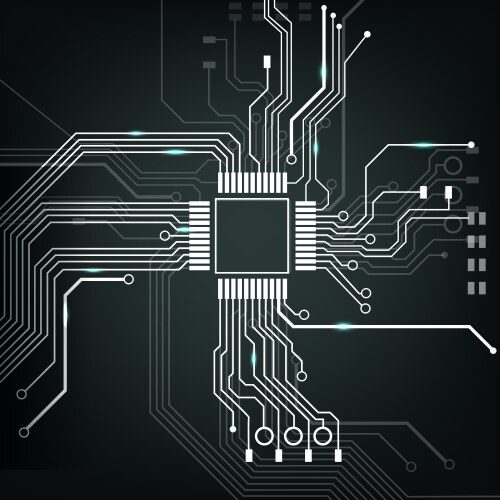
Digital electronics is a branch of electronics that deals with digital signals and circuits, where information is represented using discrete values typically in the form of binary digits (Os and 1s). Unlike analog electronics, which processes continuous signals, digital electronics manipulates signals that are discrete and quantized. This field encompasses the design, analysis, and implementation of digital circuits and systems, including logic gates, flip-flops, registers, and microprocessors. Digital electronics finds applications in a wide range of technologies, from consumer electronics like smartphones and computers to industrial automation, telecommunications, and beyond.
Digital electronics has profoundly impacted the world by revolutionizing communication, computation, and automation across various industries and aspects of daily life. The advent of digital electronics has led to the development of powerful computing devices such as smartphones, computers, and tablets, which have transformed how we work, communicate, and access information. The internet, enabled by digital electronics, has connected people globally and facilitated the rapid exchange of data, knowledge, and ideas. Furthermore, digital electronics has revolutionized industries.
Logical gates are fundamental building blocks of digital circuits, performing logical operations on one or more binary inputs and producing a single binary output. There are several types of logical gates, including AND, OR, NOT, XOR, NAND, and NOR gates. The AND gate outputs a high signal only when all of its inputs are high, the OR gate outputs a high signal if any of its inputs are high, and the NOT gate produces the complement of its input. XOR gates output a high signal if the number of high inputs is odd, while NAND gates output the complement of the AND operation, and NOR gates output the complement of the OR operation.
Logical gates are integral to the gaming industry,. In hardware, logical gates are utilized in processors, graphics cards, and other integrated circuits to process inputs, execute algorithms, and generate outputs in real-time. They enable the rapid calculation of game physics, rendering of graphics, and execution of complex artificial intelligence routines. In software, logical gates are implemented in game engines and programming languages to create logic-driven gameplay mechanics, such as decision-making algorithms for non-player characters, collision detection, and event triggering.